Senin, 16 Desember 2013
Black Widow - (Latrodectus mactans)
The bodies of both genders are shiny and hairless. Juveniles can start out brown, white and orange, growing more black as they age.
Webs are irregular in shape, but strong, and are built under stones, near openings of rodent holes and on outbuildings such as sheds, outhouses or barns. They are unlikely to leave their webs and do not go out of their way to bite humans. Females guarding eggs will be more inclined to attack and bite instead of attempt to escape from a perceived threat.
The venom in adult females is highly poisonous to humans and REQUIRES MEDICAL ATTENTION. Some people feel the bite (like a pin-prick), others do not. Pain will eventually begin at the site of the bite and then it spreads to the stomach and back with cramping in the first 8-12 hours of the bite. Other symptoms also may include: sweating, nausea, tremors, restlessness, fever and headache.
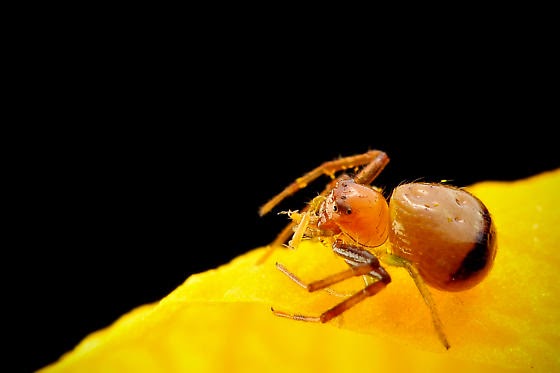
Black Tail Crab Spider - (Synema parvulum)
Crab spiders have long front forelegs that sit more forward on the body. The back pairs of legs are so much shorter and further back than the front pairs that it gives them the appearance of the kind of crab found in the ocean, on a much, much smaller scale.
In addition to the typical Crab spider physique, this particular species has a black spot on the tip of the abdomen, as if their 'butts' (abdomen) were dipped in black ink.
The crab spider does not use a web to catch prey. They ambush insects, lying in wait inside or on flowers. They have also been found on wood or tree bark. The Black Tail Crab Spider will grab its insect prey and use its front legs to help pin the victim down. It then bites the prey with its strong jaws and immobilizes it for consumption.
Because this spider preys on insects that may damage plants and flowers (like aphids), it is considered helpful to the garden ecosystem.
The Black Tail Crab Spider is not known to bite humans as it takes little interest in their activity. Their venom is not poisonous to humans. Like most spiders, however, they will defend themselves if provoked, squeezed or threatened.
Black and Yellow Garden Spider - (Argiope aurantia)
Adult Size (Length): 5mm to 28mm (0.20in to 1.10in)
Identifying Colors: black, yellow, red, silver, orange, brown
General Description: up-side-down, bands, stripes, venomous, helpful
Black and Yellow Garden Spiders are from the Argiope genus found throughout the United States of America and Canada. This species is not quite as common in the Rocky Mountain areas as they area everywhere else. The spider is easily identifiable by the distinctive yellow and black coloring found on the abdomen. The legs are equally noticeable by the alternating bands of orange and black on the legs, though this pattern may vary from spider to spider.
Females measure in larger than the males, almost four times bigger in fact. Besides being smaller, males do not promote their colors as such, and might appear a shade or two paler compared to the rich, bold colors on the female.
Webs produced by the Yellow Garden Spider are about knee-high off the ground in sunny, still areas of a garden. They are also distinct as some have a zig-zag type strand pattern called the stabilimentum running down the middle of their webs, believed to be produced by a nearby male. Additionally, their webs are built as a spiral that builds out from the center; a classic feature of all Orbweaver spiders. These spiders sit on the web up-side-down with their heads closer to the ground. Their long, lean legs make them appear substantially large and intimidating to humans. If disturbed or threatened, this spider will immediately drop to the ground.
Black-and-Yellow Garden Spiders are also called the Common Garden Spiders or Yellow Garden Spiders in various publications. Whichever name used, spotting one of these spiders is quite a treat as their unique shape and striking colors add a bit of natural "punch" to your garden. They are commonly found throughout garden areas, parks and woodlands.
Adults are most visible during summertime. Females lay eggs in a papery brown sac which is attached to one side of her web and then dies. The eggs hatch in the fall, but the spiderlings stay in the egg sac over winter, finally leaving in the spring.
Basilica Orb Weaver - (Mecynogea lemniscata)
The colors, pattern and shape of the abdomen make this spider a real stand out. With shades of green, orange and yellow, it should be difficult to miss this beauty.
This spider is part of the Orbweaver family called Aranaeidae. This is a huge family of spiders in North America. The shaped of the web created by these spiders is a circular spiral. Strands of spider silk radiate from the center of the web out to the edges. Many orbweavers rebuild their webs every day, but this species does not reconstruct a new web unless it needs to. It prefers to makes repairs to its existing web. If repairs are inefficient, it will build a new web above an old one.
The Basilica Orbweaver makes its webs dome-shaped, similar to the shape of domes seen in cathedrals. The weaving inside the dome is small and mesh-like as opposed to open and circular like the surrounding web. Dangling threads from the dome aid in creating a sticky trap. Egg sacs can also be seen hanging from a female's web. The egg sacs are white and bead-shaped, like a strand of pearls.
Adult Size (Length): 5mm to 9mm (0.20in to 0.35in)
Identifying Colors: green; orange; yellow; black; white; red
General Description: round, long, colorful, venomous
Banded Garden Spider - (Argiope trifasciata)
This spider builds its orb-shaped web between plants in garden beds. It sits in the center of the spiral web with its, up-side-down, waiting for prey to ensnare itself in the web. It keeps its dark underside facing south, likely to absorb as much solar heat as possible, enabling to stay active longer in cool weather.
Young Banded Garden spiders are a lighter brown color with white stripes. They become blacker as they mature. Their furry carapace ('neck' region) is covered in silvery hairs. This species, regardless of age, is most active from mid-summer to the area's first freeze.
They build their webs low to the ground in gardens, tall grasses or between shrubs. Like other members of the Orbweaver family, a zig-zagged cluster of spider silk called a stabilimentum can be seen near the center of the web.
Males are half the size of females and can be found at the edge of a female's web before mating. Egg sacs are brown and paper-like with a flattened side making them look like little cauldrons. Females can deliver a moderately painful bite to humans if she is guarding eggs and feels threatened or disturbed. Eggs overwinter and hatch spiderlings in the spring.
Adult Size (Length): 4mm to 25mm (0.16in to 0.98in)
Identifying Colors: black; white; yellow; brown
General Description: stripes, bands, venomous
Arrow-shaped Micrathena Spider - (Micrathena sagitatta)
The spiny ridges on females are believed to ward off predators, but some sources believe they add to her ability to conceal herself in her web. Males do not have spines and are mostly black with white edges. Females are twice as large as males. Both have ab abdomen that actually gets wide as it nears the end of the body.
Both genders spin orb-shaped spiral webs that lie in a vertical plane (up-and-down). They may only be a few feet off the ground. A short zig-zagged strand of webbing called a stabilimentum may be just above the center of the web. Spiral strands radiating from the center allow the spider to tread easily on its web. Orbweavers are known to rebuild their webs every day.
In autumn, a female will lay eggs on the edge of her web, usually on a leaf right next to it and then die before they hatch. The eggs will overwinter and hatch the next spring. These spiderlings will start out with longer abdomen than adults as well as short, stubby spines.
Adult Size (Length): 4mm to 9mm (0.16in to 0.35in)
Identifying Colors: red; yellow; black; orange; white
General Description: pointy, holes, thorny, spiny, venomous
Arrowhead Orb Weaver - (Verrucosa arenata)
Orbweaver spiders belong to the family Araneidae. This is a huge family of spiders in North America. The shaped of the web created by these spiders is a circular spiral. Silk lines will radiate from the center and many are known to rebuild their webs every day.
The more common varieties of orbweavers have a bulbous abdomen. This species does not. Its markings and abdomen shape are similar to an arrow tip. It makes for a unique body shape. The darkness of the body can vary between spiders as can the color of the 'arrowhead'. Some of the triangular markings are white or pink instead of yellow. The color pattern on is the same among Arrowhead Orbweaver spiders living in the same area.
This spider creates webs in shaded areas of a forest and sits on it with its head up while most other spiders keep their heads down. The legs are tucked in at their sides as it awaits prey. Like other spiders, once an insect wanders into its web, the spider immobilizes it with a bite and eats it later.
They are most active in middle and late summer. They can be found in wooded forests, hiding in the darker, shaded areas.
Adult Size (Length): 5mm to 6mm (0.20in to 0.24in
Identifying Colors: red; brown; yellow; white; pink
General Description: pointy, arrow, triangle, patch, tucked, venomous
Langganan:
Postingan (Atom)

_The_Western_Widow_(2800388371).jpg)